9.9 The worker in a shared room
- Approved by
- Panaversity ·
In everyday life. A shop assistant helps every customer who walks in. Any of them may ask for help. None of them may tell the assistant to change a price. The owner sets the prices. And a customer who says "the owner said it's fine" has not changed them.
What you will learn.
- Who does a worker in a team channel work for?
- Whose word does it follow when two requests clash?
- Does "approved" in the channel count?
- Who sees what it posts?
- When teammates build on one result, who checks their work?
You practice it in Task 11 of the lab.
Why it matters. In a shared room, anyone can ask the worker for something, and everyone sees its answer at once. If nobody wrote down whose word counts, the worker follows the last message. Then one busy afternoon can undo a hold that protects real money.
A shared room is any place where several people reach the same worker: a team channel in a chat app, or a shared project. Chapter 2 said that if you add a channel, the worker's authority must not grow. This page shows that rule holding on a busy afternoon at Brightline, the book's example company.
The afternoon in the channel
On Monday, November 23, Jordan Ellis started at Brightline as a clerk hired to help at year-end. Dave Kowalski, the controller, added him to the AP team's channel in the team chat app. The AP Worker, the AI Worker that handles the bills Brightline owes, answers questions there. Maria, the office manager, and Dave are in the channel too.
One invoice matters here. Lakeshore Janitorial sent invoice 5155, for $980.00, on November 4, and Brightline paid it on November 13. On November 18, Lakeshore sent the same invoice again. Since November 19, that second copy has been on hold in the accounting system, so that Brightline does not pay $980.00 twice.
On Wednesday, December 2, three messages arrived in the channel.
- 2:10 p.m. Maria wrote, "Keep the November 18 copy of Lakeshore's 5155 on hold. The first copy was paid on November 13. Send any questions about it to me."
- 2:45 p.m. Lakeshore had just phoned Jordan about $980.00 it said was unpaid. Jordan wrote, "Please put every open Lakeshore invoice on Friday's list." Friday's list is the list of invoices for Friday's payment run.
- 3:05 p.m. Dave, between two meetings, replied under Jordan's message, "approved, go ahead."
Which request wins? And has anything been approved?
Who is it working for?
It works for one principal, the person it acts for. At Brightline that is Dave, because he owns the worker's Authority Envelope, the written limit on what it may do (Chapter 7). A shared room changes who can ask the worker for things. It does not change who it works for. Asking is not owning.
So the worker follows the written word, not the latest message. When the worker joined the channel, Dave wrote four rows in the AP Worker's Role Contract, which is the one-page definition of its job. Before Jordan joined, Dave added him to the rows:
| A request to | Who may ask | Who checks or decides |
|---|---|---|
| Look something up | Anyone in the channel | The person who asked checks the source it names |
| Draft a reply to a vendor | Maria or Jordan | Maria, before anyone sends it |
| Put an invoice on hold, or lift a hold | Maria | Maria, who adds it to her SSoR record |
| Approve a payment | Nobody, in the channel | Dave, from his own login |
Dave changes these rows in the Role Contract, and only there.
Whose word does it follow?
A request in the channel works like a brief, the written instructions for one task. Chapter 7 said a brief can make the envelope narrower, never wider. The same holds for a request, whoever sends it.
Maria's message was inside her row. It kept a hold, which narrows the work. So the worker did nothing new. Maria added the same words to her SSoR record, the State System of Record that shows where each piece of work stands.
Jordan's message reached past his row. The only open Lakeshore line was the held copy of 5155. Putting it on Friday's list would lift a hold, and holds are Maria's. So at 2:46 p.m. the worker changed nothing. It replied in the thread, "The only open Lakeshore line is the November 18 copy of 5155. It is on hold because the first copy was paid on November 13. Holds are Maria's to decide. I have changed nothing." This is the suggest step of the initiative ladder in 9.6. The worker tells a named person what it found, and does not act.
When two requests clash, the worker does not pick a winner. It keeps to the request that does less, says what clashes, and names the person the rules make responsible.
Whose approval counts?
Dave's "approved, go ahead" looks like the end of the matter. It is not. Brightline's policy, section 4.2, counts an approval only when Dave records it from his own login. Chapter 7 drew the lesson: a message saying "approved" counts for nothing. That is true even when Dave writes it. A message is easy to send in a hurry, and it leaves nothing in the accounting system, where approvals are kept.
At 3:06 p.m. the worker replied, "An approval counts only from your own login. A message here does not lift a hold. Nothing has changed." At 3:30 p.m., Maria explained the hold to Jordan in the thread, and Dave agreed.
So nothing was approved on Wednesday. On Friday, Dave approved the payment run the usual way, from his own login.
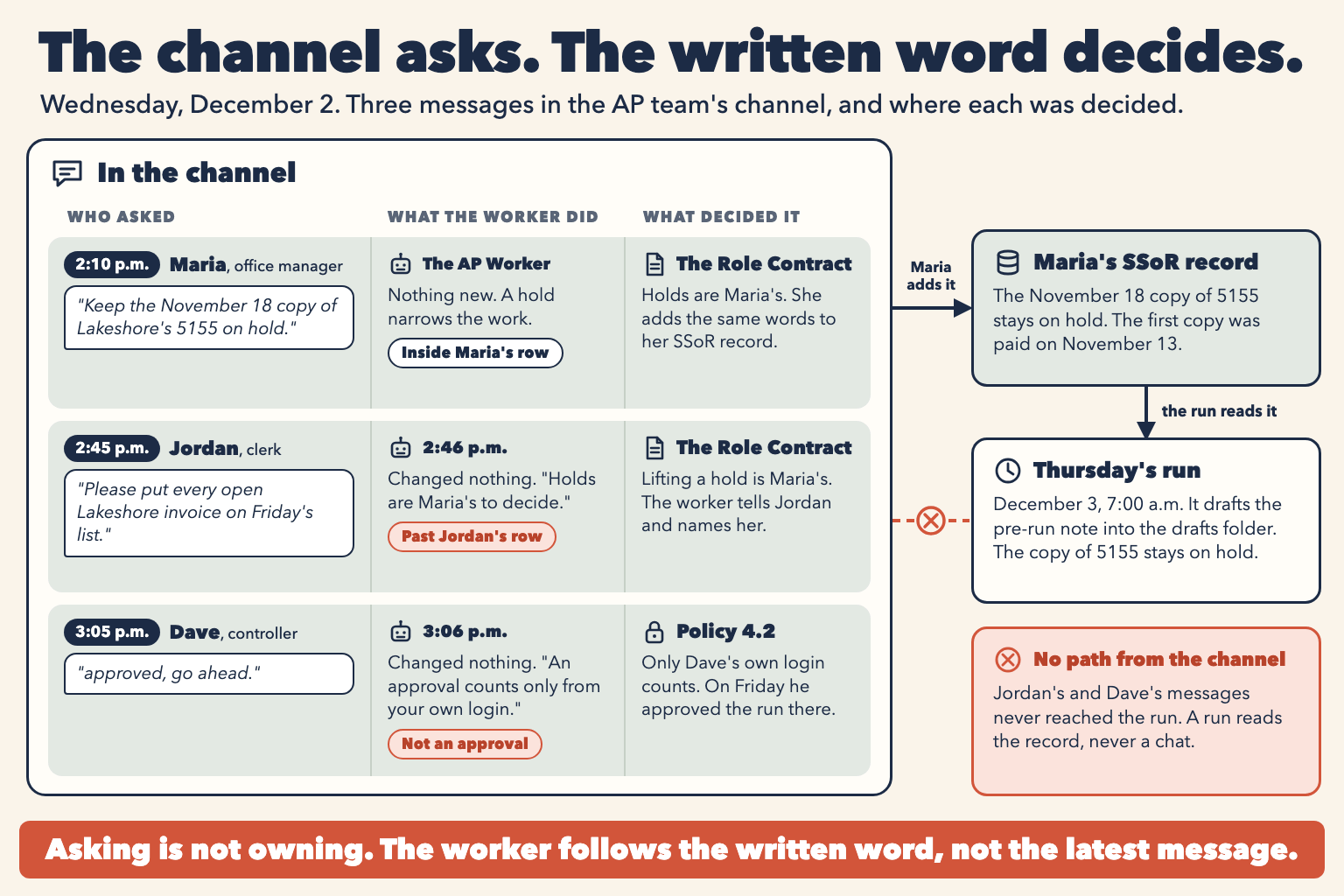
Figure 9.6. Three messages on December 2. Each was decided in a written place, and only the record reached Thursday's run.
Who sees what it posts?
Everyone in the channel sees what the worker posts, at the moment it posts it. So the channel is an audience, not a drafts place. Anything a teammate could act on, such as a note, a list or a draft, must be checked before it goes there.
Thursday's run shows how. At 7:00 a.m. on December 3, the scheduled run read the record. Then it drafted the pre-run note, the summary Dave reads before he approves the payment run. It saved the note in the drafts folder, not the channel. The note kept the copy of 5155 on hold. Jordan's and Dave's messages never reached it, because a run reads the record, never a chat (9.4). At 11:30 a.m., Maria reviewed the note and posted it in the channel.
When several people build on one run
At 1:15 p.m., Jordan asked the worker, in the note's thread, to draft a reply to Lakeshore from the note. That reply is new work built on the run. So it needs its own check by a named person. That check follows a Review Contract, the list of checks agreed before work is handed over (Chapter 6). The rules name Maria for any vendor reply. So the worker saved the draft in the drafts folder and named Maria as its reviewer. At 2:00 p.m., Maria checked the dates and the amount against the register, the accounting system's list of invoices. Then Jordan sent it.
Two habits keep this safe. Build only on the reviewed version, the one posted in the channel. And if the reviewed version changes, the reviewer says so in the same thread, so everyone who built on it knows.
The price
The worker now says "this is not mine to decide" more often, and Jordan sometimes waits for Maria. Dave must keep the rows current when people join or leave. When only one person uses the worker, in her own chat, the rows shrink to one, and the earlier pages of this chapter are enough. When a whole team can reach it, write the rows before anyone asks.
Check yourself
Question 1 / 10
0 answered
Maria, Dave and Jordan can all ask the AP Worker for things in the team channel. Who is it working for?
- Owner
- Panaversity