9.1 Is this an agent problem?
- Status
- stable
- Owner
- Panaversity
- Approved
- Panaversity ·
In everyday life. You would not hire an accountant to add up one receipt. And you would not write a recipe card for a meal you will cook once.
What you will learn. How to decide, with three questions, whether work that repeats should go to an AI Worker at all, and when a fixed path is enough. You practice it in step 1 of the lab.
Why it matters. Some repeating work does not need a worker. An ordinary tool, or a chat each time the work comes up, can be cheaper and safer than something you must build and check every week.
Before you hand recurring work, work that repeats, to an AI Worker, ask whether it needs one. Put the work through three gates, three questions asked in order.1 Any gate can stop it.
Gate 1. Does an ordinary tool already do it? A total, a lookup, a sort or a standard report belongs in the tool that was built for it. At Brightline, the book's example company, Maria, the office manager, thought of asking the worker to add up payments by vendor each month, for year-end tax forms. Gate 1 stopped her. The accounting system already prints that report. A worker adds cost and a chance of error to a sum. If a result matters, compute it.2
Gate 2. Once, or every week? Three dials decide, and each one can be up or down. Frequency: does the work come back regularly? Consistency: do the inputs and the finished output have the same shape each time? Payoff: is the time you save, or the error you avoid, worth the cost of building and checking it? If all three are up, it is worth making recurring. Go on to Gate 3. If any one is down, build nothing. Handle the work in a conversation each time it is needed. A useful signal: the third time you do the same task the same way, stop and run Gate 2.
Gate 3. What does finished look like? Write down the input, the output format, and one check you can do in under a minute. For Maria's Thursday list, the check is: is every invoice on it open, and due by the Friday after the run? If you cannot write that check, the work is not ready to run without you.
One more question comes after the three gates: does the work need judgment at each step, or does it follow a fixed path? A fixed path, such as "every Thursday, list invoices due by the Friday after the run," can be a simple scheduled job with a fixed brief. An agent, a model that works in a loop with tools and decides its next step, is worth its cost when the steps depend on what it finds, when the rules have exceptions, or when the inputs are messy.3 Reading scanned invoices that come in many different layouts is an example: each week brings the same kind of input, but each invoice looks different. Choose the simplest approach that works, and add judgment only where the work needs it.4
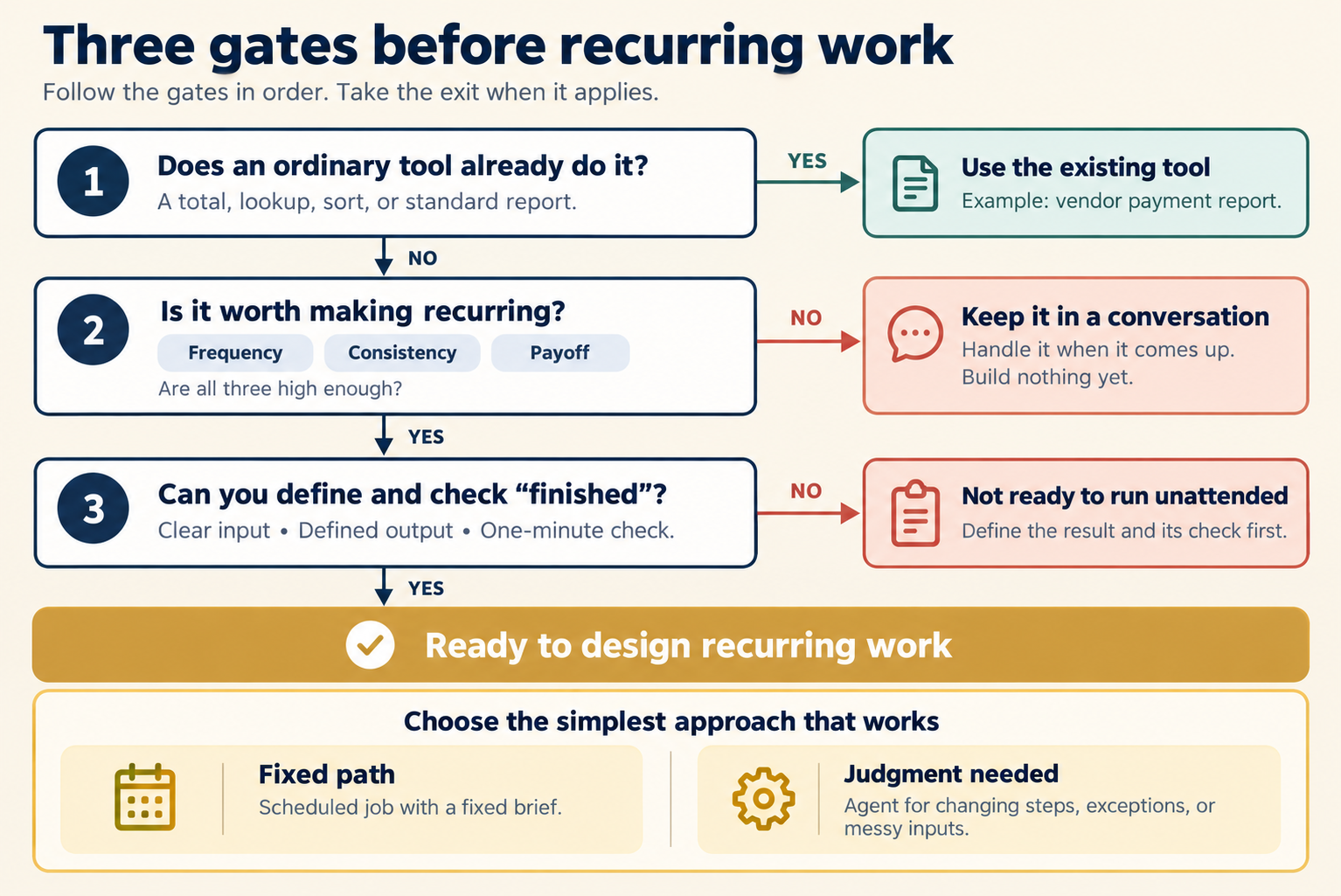
Figure 9.1. Three gates before any recurring work.
Check yourself
Question 1 / 7
0 answered
A team wants a worker to add up vendor payments each month. The accounting system already prints that report. What fits best?
Sources
Chapter 9. Work That Runs Without You
How to decide whether recurring work should go to an AI Worker, fit it into the workflow your team already runs, start it on a schedule or when something happens, keep each run informed of what earlier runs found, govern what a worker does that nobody asked for, and explain the setup to the people who rely on it, on Claude or on ChatGPT.
9.2 Fit AI into the workflow you already have
How to place a worker in the steps your team already follows: map each step, decide who owns it, avoid three common mapping errors, and measure before you switch.