Certification and Portfolio Roadmaps
- Status
- stable
- Owner
- Panaversity
- Approved
- Panaversity ·
The point
This chapter helps you decide two things: which exam comes next, and what you should have built by then. The certification map shows the path through Panaversity's PCxx exams, the gate into the FDE Internship Program, and the Anthropic certification that matches each exam. The portfolio map shows the parts each reader route reads and the portfolio it produces. Together they connect the certification journey to the economic journey: how capability becomes income.
Certifications are milestones, not the product. The product is a portfolio a stranger can check.
Terms on this map
- Milestone: a checkpoint for the work you build, lettered A to F. The portfolio map below lists what each one needs.
- FDE: Forward Deployed Engineer. A vertical FDE builds and deploys AI Workers for one vertical. A vertical is one body of professional work.
- KSoR: Knowledge System of Record, the governed, authoritative knowledge layer. KSoR governs what an AI Worker may know.
- DSoR: Data System of Record, the governed layer between workers and real systems. DSoR governs what an AI Worker may do.
- SSoR: State System of Record, the governed record of work in progress: open commitments, task status and what has already happened. SSoR governs what an AI Worker may take as true right now.
- Slice: one professional outcome for a vertical, covered completely.
- Role Contract: the portable business definition of a worker.
- Review contract: the acceptance criteria, set before delegation.
- Snapshot rehearsal: a short summary of where your exam's guide and today's products differ, and a practice set matched to the guide version. You work through both before an official Anthropic exam.
The certification map
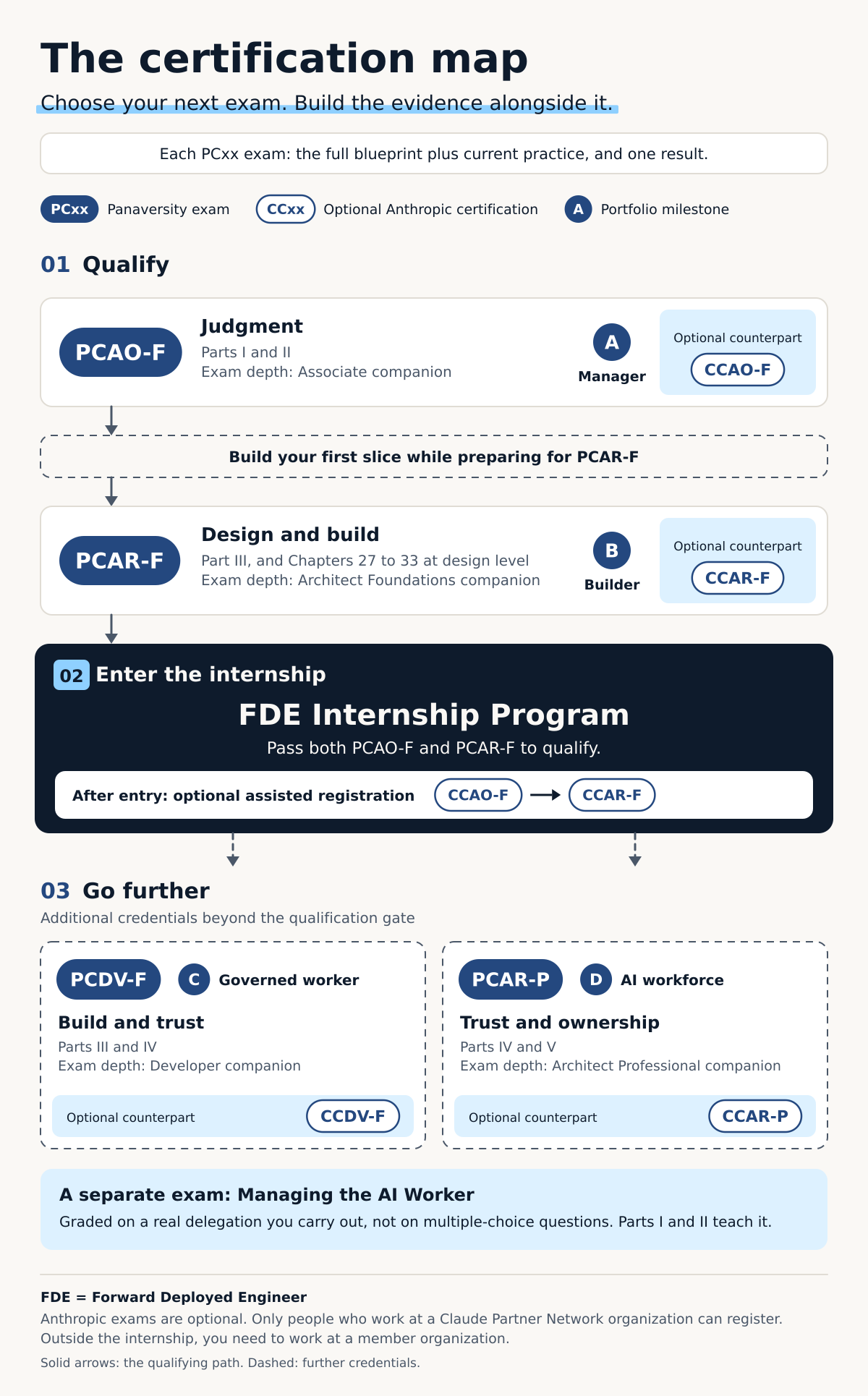
How far you go on this map depends on your route. On the leader route, you take no exam. On the everyday professional and domain-expert routes, you take one exam, PCAO-F. On the builder route, you go on to PCAR-F and the internship, and then to PCDV-F.
Qualify. Pass PCAO-F.1 Then build the first slice of your work while you prepare for PCAR-F, and pass PCAR-F.2 You do not have to study with Panaversity to take these exams.3
Enter the internship. Passing PCAO-F and PCAR-F qualifies you for the FDE Internship Program. After you enter it, you can get assisted registration for CCAO-F and CCAR-F: Panaversity helps you register. The Anthropic exams are optional.3 Anthropic currently offers them only to people who work at organizations in the Claude Partner Network.4,5 You register yourself, with a company email address from that organization. A personal address does not work.6 If you do not enter the internship, you need to work at a member organization.
Go further. PCDV-F7 and PCAR-P8 are additional credentials beyond the gate.
| PCxx exam | Anthropic certification, optional | What it tests | Taught in | Exam depth in | Portfolio by then |
|---|---|---|---|---|---|
| PCAO-F | CCAO-F9 | Judgment | Parts I and II | Associate companion | A. Manager |
| PCAR-F | CCAR-F10 | Design and build | Part III, and Chapters 27 to 33 at design level | Architect Foundations companion | B. Builder |
| PCDV-F | CCDV-F11 | Build and trust | Parts III and IV | Developer companion | C. Governed worker |
| PCAR-P | CCAR-P12 | Trust and ownership | Parts IV and V | Architect Professional companion | D. AI workforce |
The Managing the AI Worker exam is separate from the exams in this table. It is graded on your work, not on multiple-choice questions. You carry out a real delegation and hand in five pieces of work:
- a Four-Part Brief
- a Review Contract, written before you delegate
- an Authority Envelope
- your review of a run you did not watch
- your diagnosis of a failed run
Parts I and II teach all five. PCAO-F stays the knowledge exam.
CCAO-F, Anthropic's Associate exam
CCAO-F tests how you use Claude at work. It is for professionals who use Claude as a productivity tool, not for software developers. It has 60 questions. Some have one right answer. Others describe a scenario and have more than one, and each question says how many to pick.9,6 Its seven domains carry these weights:
| Domain | Weight |
|---|---|
| Prompting and Task Execution | 14 percent |
| Output Evaluation and Validation | 21 percent |
| Product and Model Selection | 12 percent |
| Workflow Integration and Solution Design | 16 percent |
| Configuration and Knowledge Management | 12 percent |
| Governance, Risk, and Responsible Use | 15 percent |
| Troubleshooting and Optimization | 10 percent |
How PCxx exams relate to Anthropic's
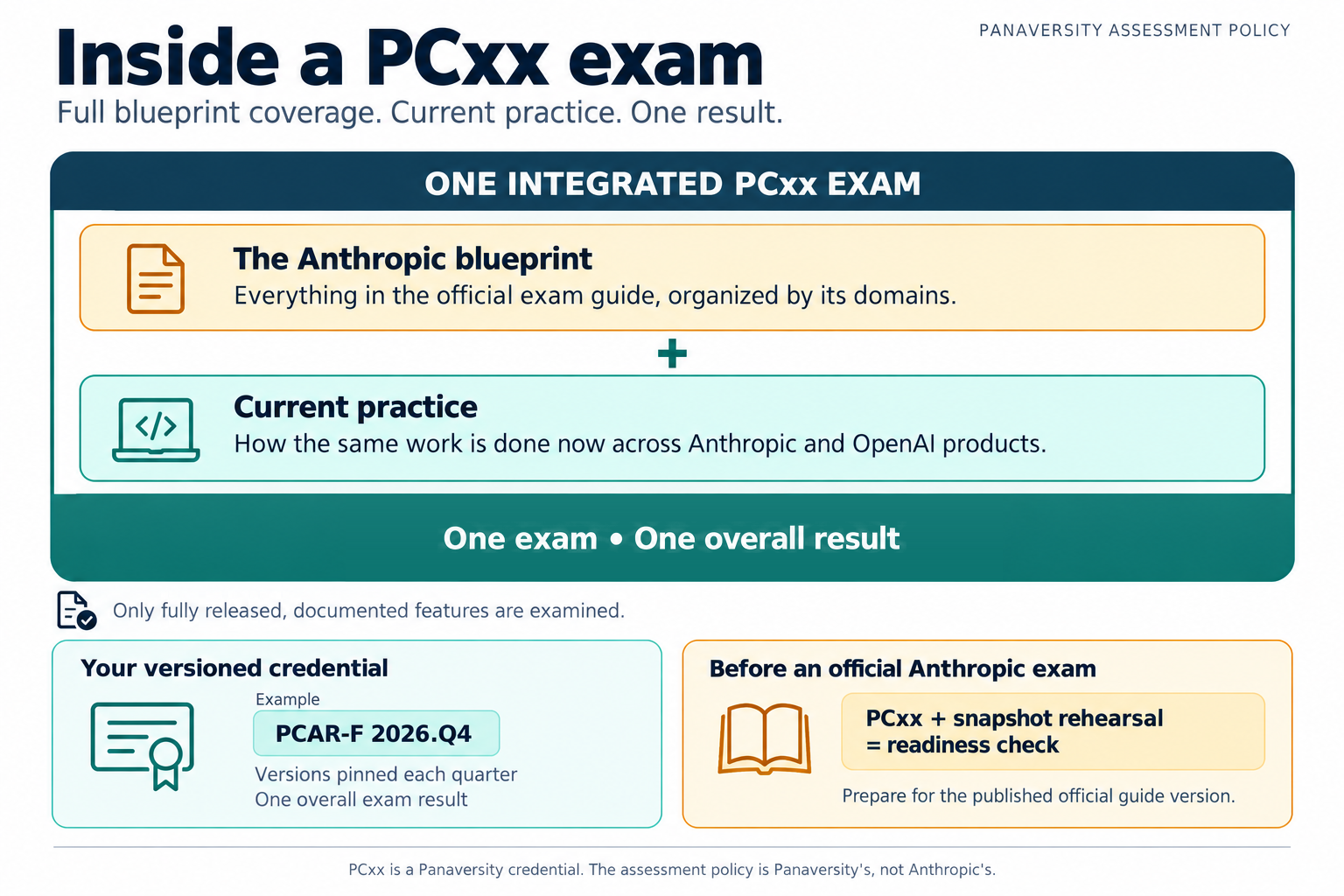
Each PCxx exam is a single exam with one passing score,13 720 out of 1,000. It covers two things:
- The Anthropic blueprint: everything the official exam guide covers, organized by its domains.3 A domain is one topic area of the exam.
- Current practice: how the same work is done now, on both Anthropic's and OpenAI's products.1
This design is Panaversity's own assessment policy, not Anthropic's.3 Only fully released, documented features are examined. Each quarter of the year has one fixed exam version. The credential shows its version, for example PCAR-F 2026.Q4.
A PCxx exam is a credential, not a rehearsal exam. Before an official Anthropic exam, PCxx plus the snapshot rehearsal is your readiness check.
The portfolio map
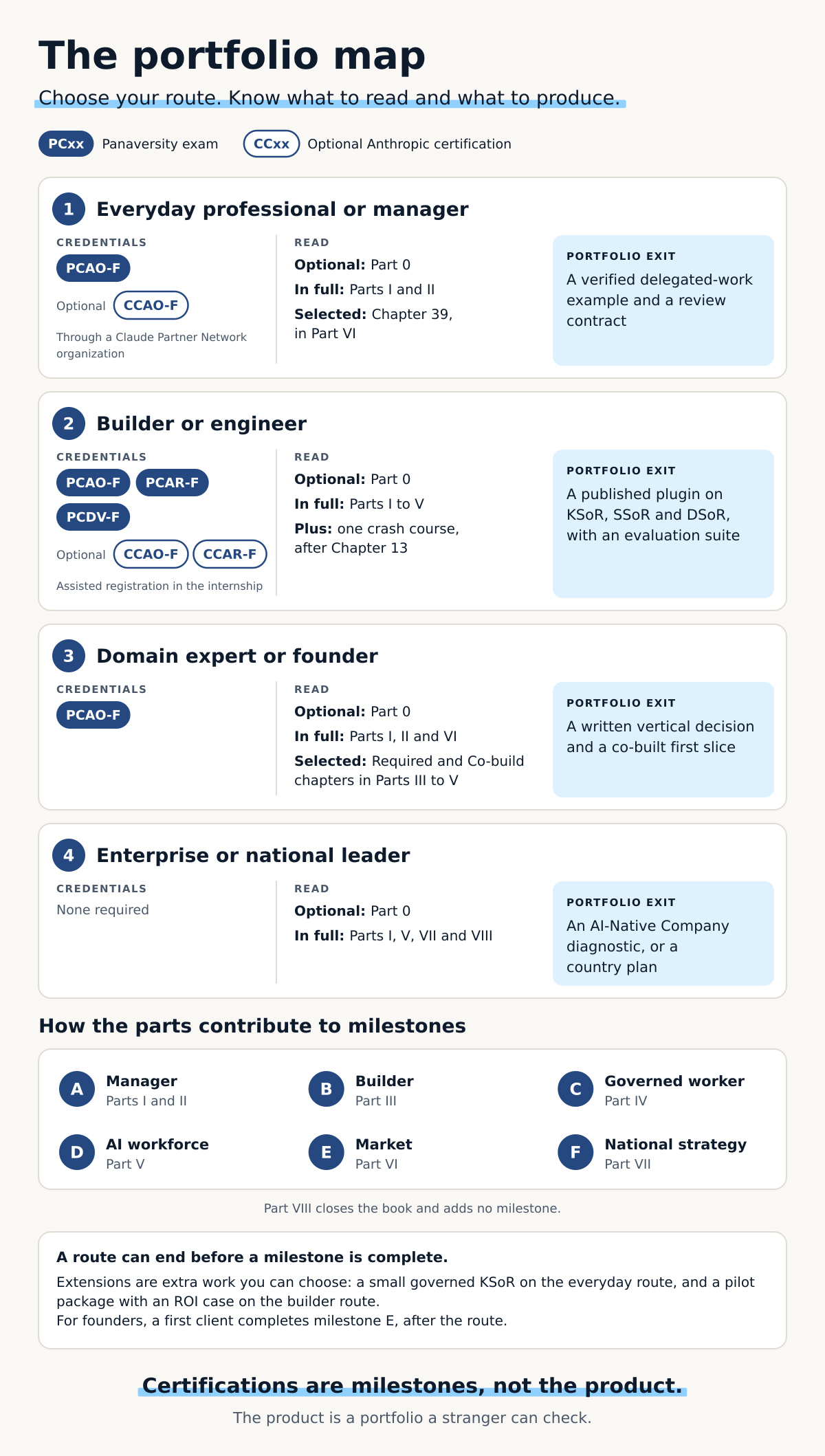
How to Use This Book lists each route's chapters, credentials, portfolio exit and reading length. A route's portfolio exit is what you have built when you finish it. Part VIII is the closing chapter and builds no milestone.
| Milestone | Parts | Evidence |
|---|---|---|
| A. Manager | I, II | A verified delegated-work example, a review contract and a small governed KSoR |
| B. Builder | III | A Role Contract, a plugin and a design document, ported between vendors |
| C. Governed worker | IV | A served KSoR, DSoR stages, an SSoR tracking live work state, an evaluation suite and one transaction traced across all three |
| D. AI workforce | V | A pilot package with a return on investment (ROI) case |
| E. Market | VI | A vertical decision, a published slice and a first client |
| F. National strategy | VII | A country or institutional plan |
A route can end before a milestone is complete. The everyday professional route ends with a verified example of delegated work and a review contract. It leaves out milestone A's small governed KSoR. The builder route ends with a published plugin on KSoR, DSoR, and SSoR, with an evaluation suite. It leaves out milestone D's pilot package. On these two routes, the missing piece is an extension: extra work you can choose to do. The domain-expert route ends with a written vertical decision and a co-built first slice, which you make while you learn. Milestone E also needs a first client, and that comes after the route.
Milestones, not the product
No certification on its own guarantees a job or income. Chapter 39 explains what a credential from a supervised exam proves, and what it does not. It also explains why a credential without a build is weak evidence. Part VI teaches you to sell your work and get paid, from any country. It builds toward a portfolio a stranger can check: credentials, a published plugin, public KSoR, DSoR, and SSoR work, and a demo.
Every part opens with a "You are here" panel. It shows where you are on all three journeys, the portfolio artifact the part produces, and what comes next. Those panels show these maps, one part at a time.
So read the two maps together. On the certification map, find your next exam and the milestone in the same row. On the portfolio map, see which parts your route reads and where it ends.
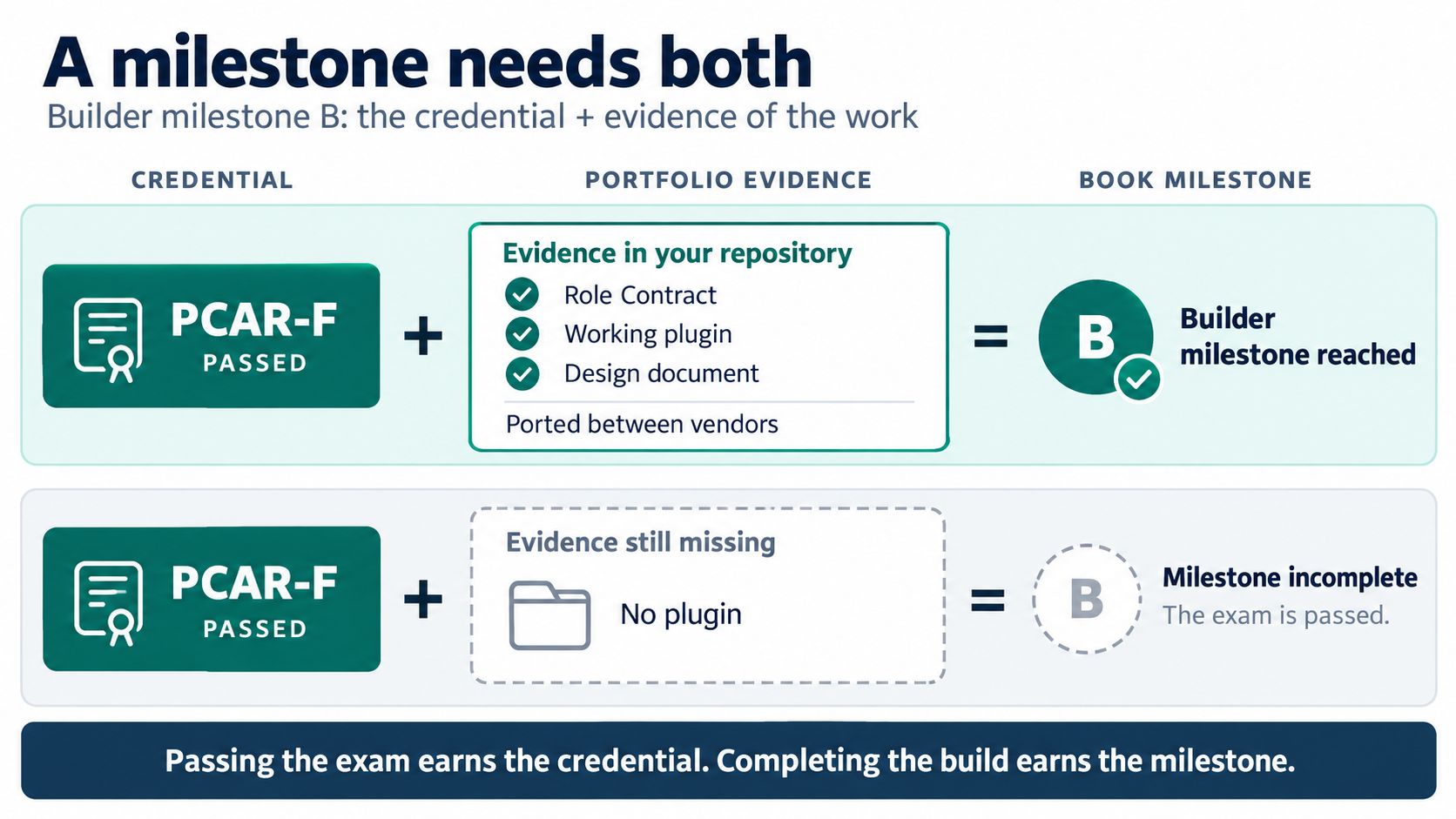
Imagine a builder who has just passed PCAO-F. The next exam is PCAR-F. The milestone beside it is B: a Role Contract, a plugin and a design document, ported between vendors. If that builder passes PCAR-F with no plugin, the exam is done but the milestone is not.
Appendix C holds the certification guide and the objective map. The objective map shows where the book or a companion teaches each skill an exam tests. The companions are updated when Anthropic's exam guides or the products change.
Next comes Part I. Read its "You are here" panel first.
Flashcards
The exam path, the internship gate, and why a milestone needs both the exam and the work.
Sources
- Panaversity Certified Associate: Foundations (PCAO-F), The AI Agent Factory, first edition.↑↑2
- Panaversity Certified Architect: Foundations (PCAR-F), The AI Agent Factory, first edition.↑
- Certifications: Proof You Can Carry In, The AI Agent Factory, first edition.↑↑2↑3↑4
- Four role-based Claude certifications, Anthropic, 23 July 2026.↑
- Who can take a Claude certification exam, Anthropic Partner Academy.↑
- FAQ - Certifications, Anthropic Partner Academy.↑↑2
- Panaversity Certified Developer: Foundations (PCDV-F), The AI Agent Factory, first edition.↑
- Panaversity Certified Architect: Professional (PCAR-P), The AI Agent Factory, first edition.↑
- Claude Certified Associate: Foundations Exam Guide, version 1.0, Anthropic, effective July 2026.↑↑2
- Claude Certified Architect: Foundations Exam Guide, version 1.0, Anthropic, effective July 2026.↑
- Claude Certified Developer: Foundations Exam Guide, version 1.0, Anthropic, effective July 2026.↑
- Claude Certified Architect: Professional Exam Guide, version 1.0, Anthropic, effective July 2026.↑