0.4.3 Putting the 4Ds together
- Approved by
- Panaversity ·
In everyday life. In your own town, you can buy what you forgot on the way. On a week's trip into the mountains, you cannot. Whatever you leave off the packing list stays at home. So you write the list before you go. When you come back, you add what you missed, ready for the next trip.
What you will learn. How the four Ds work as one loop, even when nobody is watching. The four beginner mistakes, the daily checks, and where each D goes deeper.
Why it matters. When nobody watches the work, a page written before it starts carries everything you would have said.
The 4D loop
How do the four Ds work as one loop?
This book joins the four Ds into one loop, the 4D loop. You delegate, describe and discern, then go round again as needed, and you are diligent the whole way round.1 In the chat at the start of this chapter, the loop went round in twenty minutes, with you at every turn. You decided what went in, judged the 2:05 table, corrected the job and the description, and told Dave that AI drafted it.
What does the loop look like when nobody is watching?
It spreads over days, and a person acts only at its two ends. Here is Brightline's monthly vendor-statement reconciliation, done that way. On Monday, August 24, at 9:00 a.m., Dave writes its 4D plan, a page with each D's lines and when each is done. He writes it in markdown, with the marks 0.3 teaches. The Preface asked you to write the rules you would give a worker for a weekly task. Those were Delegation and Description lines, and Dave's page adds the other two.
| The D | Dave's lines | When |
|---|---|---|
| Delegation | Compare the statement with the register, and explain every difference. Change nothing, and contact nobody. Every correction waits for Dave. | Before the first run |
| Description | One row per difference, with its amount and its reason. Where the statement shows no reason, write "the statement does not show" instead of a guess. | Before the first run |
| Discernment | The next morning at 9:00, Dave reads the table and the run's record, and checks two differences against their invoices. | After each run |
| Diligence | Only the statement and the register go in. The table says that AI made it. Nothing reaches Buckeye Office Supply until Dave signs. | Throughout |
Now the same job, with nobody at the chat. On Tuesday, September 1, at 2:00 p.m., the same afternoon as this chapter's story, the run starts on its own, because it was set to start once the month ends. Nobody is watching it. It reads the page, the statement and the register, and it leaves a table and a record of what it did. On Wednesday at 9:00 a.m., Dave does what his Discernment line says. Both differences match their invoices, so he signs, ahead of the deadline on Thursday, September 3. If a check fails, Dave fixes the page before the next run, and the loop goes round again.
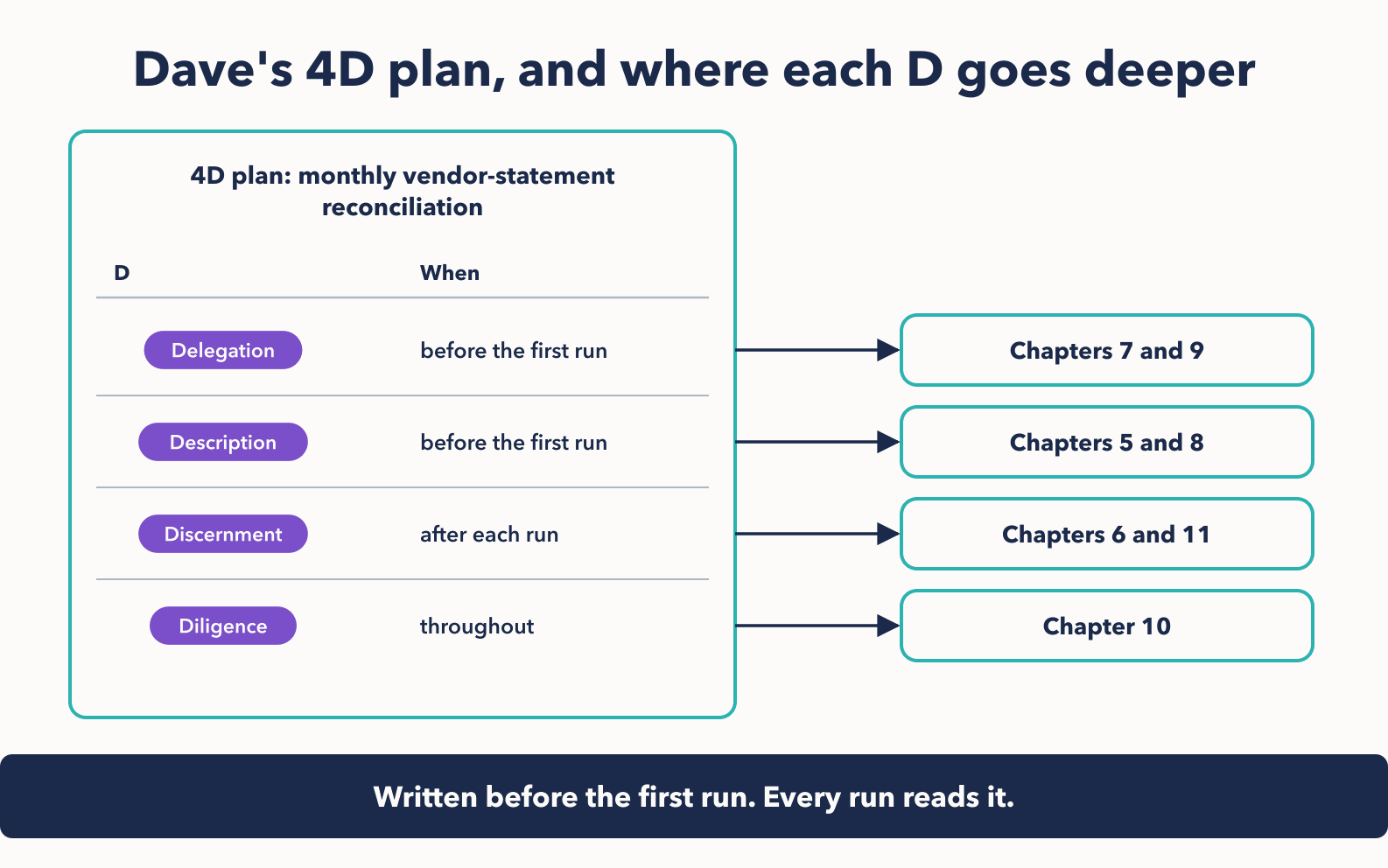
Figure 0.4.3. The 4D plan is written before the first run, and every run reads it. Each D points to the chapters that teach it in more depth.
A mistake in a chat, and in a run
What are the four beginner mistakes?
Each one is a missing D.1 In a run, nobody is there to catch it.
| The mistake | The missing D | In a chat, caught at the next turn | In a run, it reaches the output |
|---|---|---|---|
| Typing before you decide the job | Delegation | At 2:05 you stop a table that removes the differences. | No line says "change nothing", so the differences are removed. |
| Taking a weak first answer as the last | Description | You add what the first answer lacked. | The page is all the run gets, so what the page leaves out, the table leaves out. |
| Trusting a tidy answer because it looks finished | Discernment | You check a row against its invoice before you send it. | Unless someone reads it at a set time, it goes into the accounts unread. |
| Thinking about data and responsibility too late | Diligence | You leave out what the job does not need, and tell Dave that AI drafted it. | Whatever the plan lets in goes in. With no line on who signs, nobody takes responsibility for the table. |
A daily checklist
What do you check every day, and when?
Four questions, one for each D.1 In a chat, you answer them as you go. When the AI works alone, the 4D plan answers them.
| The D | Ask | When the AI works alone |
|---|---|---|
| Delegation | What is the goal? What does the AI do alone, and what waits for a person? | Answered before the first run |
| Description | What output, steps and behavior does the AI need? | Answered before the first run |
| Discernment | How will I know the output is right, and how it was made? | Decided before, and answered only after each run |
| Diligence | What may go in? Who must know that AI was involved? Who signs? | Decided before, and signed after each run |
Before the AI works alone, Delegation also needs the setup check from 0.2.2.
Where each D goes next
Which chapters deepen each D?
Delegation goes deeper in Chapters 7 and 9, Description in Chapters 5 and 8, Discernment in Chapters 6 and 11, and Diligence in Chapter 10.
Chapter 3 gives all work with AI one rhythm: when you do your parts of the work, before the AI starts and after it finishes.
Check yourself
Question 1 / 10 · drawn from 13
0 answered
When does Dave write the 4D plan for the monthly reconciliation?
Sources
- Owner
- Panaversity