10.6 Ownership, approval and takedown of knowledge
- Status
- stable
- Owner
- Panaversity
- Approved
- Panaversity ·
In everyday life. A restaurant stops using a recipe that caused allergic reactions. Removing the main copy of the recipe is not enough. Every printed copy taped up in the kitchen must also come down.
What you will learn. Why every piece of knowledge needs an owner, how removing knowledge differs from replacing it, and how to remove every copy that people and AI tools can still read. You practice it in step 5 of the lab.
Why it matters. An AI Worker answers from what it can reach. Old notes that nobody owns can keep giving wrong answers long after the rule changed.
You can trust an AI Worker only as much as you can trust what it is allowed to know. Chapter 8 showed how a KSoR concept, a short file in the Knowledge System of Record that holds the rules for one topic, moves from draft to stable, the status that may be served, once an authorized person approves it. Served means given out as the current answer to people and AI tools. A concept becomes deprecated, marked as replaced, when a newer version, its successor, replaces it.1 Two more rules complete the lifecycle, the stages that knowledge moves through.
Every piece of knowledge needs an owner. The owner is the person who can approve it, change it and deprecate it. Knowledge with no owner cannot be governed. At Brightline, the book's example company, the onboarding notes for new staff, written in 2025, had no owner. In November 2026 they were removed from the AP Worker's project (Chapter 8). But a second copy, in the project for new staff, stayed. Nobody removed it, because nobody was responsible for doing so.
Takedown is a separate, recorded withdrawal. It is different from deprecation.
| Deprecated | Taken down | |
|---|---|---|
| Why | A newer rule replaced it | It should not be served at all: wrong, unsafe, unlicensed, or holding data that must be removed |
| Shown to people | Yes, pointing to its successor | No |
| Served to workers | No | No |
| Who can do it | The owner, or a takedown authority | A named takedown authority |
| What is recorded | Who deprecated it, when, and its successor | Who withdrew it, when and why |
A takedown must reach every place where the knowledge is served or can be retrieved. KSoR is one record that is published to many places, such as a website and an MCP server, a standard way for AI tools to read it. KSoR calls these places projections.1 Files uploaded by hand into an AI vendor's project are copies, not projections (Chapter 8). Withdrawing the concept does not withdraw a copy that someone uploaded months ago. That copy is frozen, so it does not change when the concept does. Deprecating the concept does not change it either. The takedown record lists each served copy, when it was removed, and a check that it can no longer be retrieved. A copy kept as evidence moves to restricted storage, a place that no worker and no one in the audience, the people allowed to read the knowledge, can reach. The takedown record says so.
KSoR names its takedown authorities, the people allowed to order a takedown, in a governance file and records every takedown in a ledger.1 Chapter 28 uses its tools. In Part II, the copies are uploads and shared folders. KSoR's workflow does not withdraw them automatically. So you do takedown by hand, once the takedown authority has decided: write the takedown record, remove every served copy, check it is gone, and tell the people who relied on it.
The right to use material matters here too. Only bring in material you are allowed to copy. A paid industry report that is licensed for reading may not be pasted into a project, no matter how useful it is.2
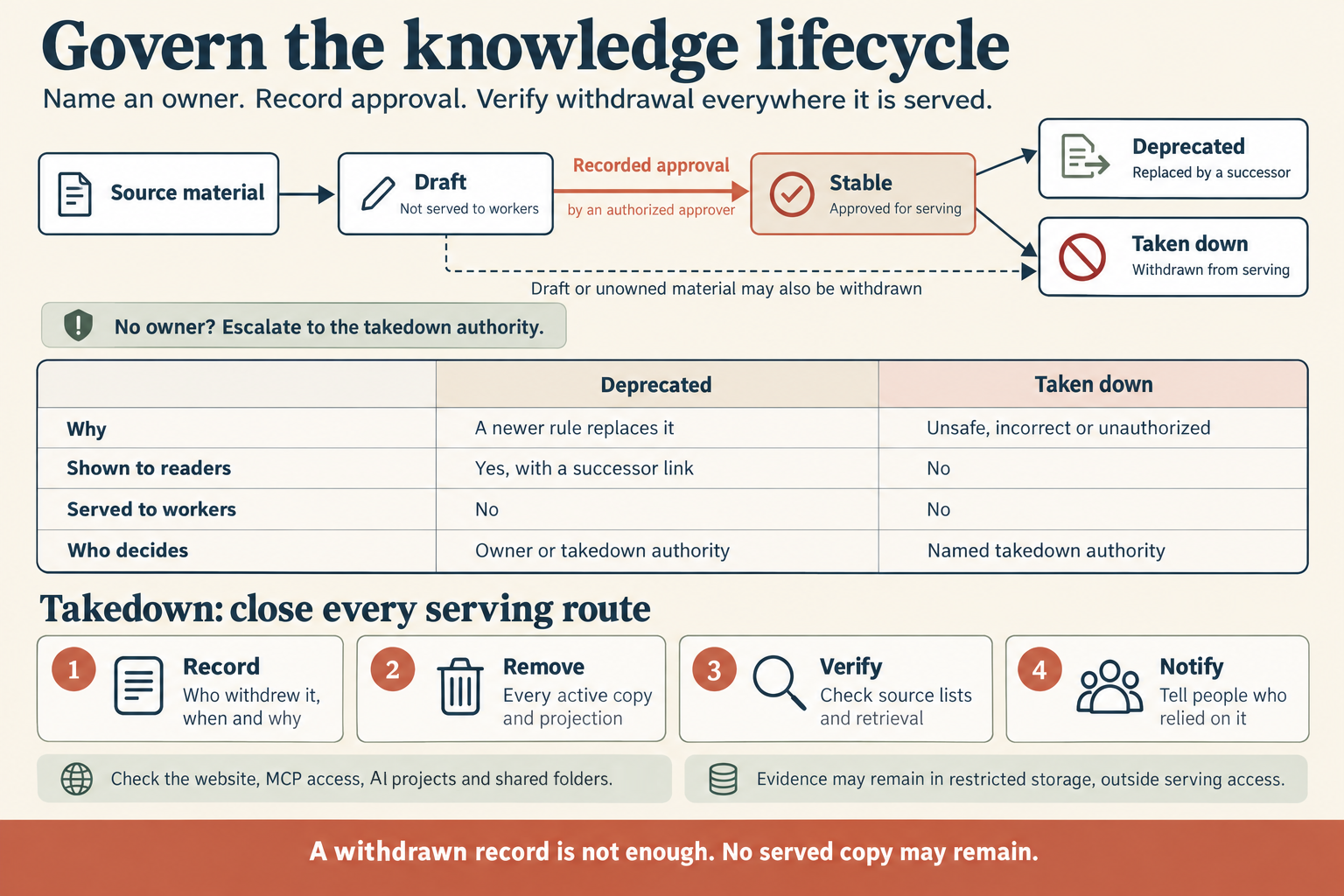
Figure 10.3. Owner, approval, deprecation and takedown. A takedown is not finished until no served copy remains.
Check yourself
Question 1 / 8
0 answered
Why did nobody remove the new-staff project's copy of Brightline's 2025 onboarding notes?
Sources
10.5 The people: who is affected, and who was left out
How to check who an AI Worker's output affects, including the people a list leaves out, and when to tell people that AI was involved.
10.7 When a human must sign
Which outputs a person must sign, how to name who checks what and when, and how to stop a worker from sending what only a person may release, on Claude and on ChatGPT.